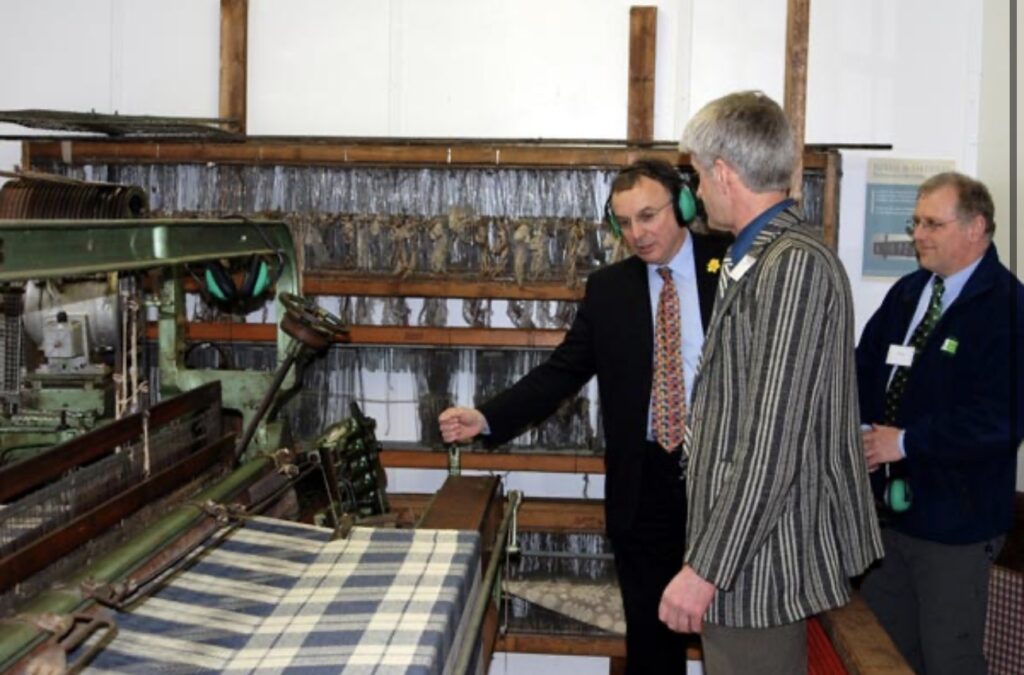
In April 2006 the Heritage Centre received an Objective One Grant through the Welsh Assembly Government for a project to restore and display Woollen Mill equipment originally from the Abbey Woollen Mill in Neath and last used at the former Maritime Museum in Swansea.
The Woollen Mill houses a working Dob Cross Loom, which we use to weave our very own Gower blanket. Using other restored equipment we demonstrate traditional techniques of weaving, spinning carding & fulling.
Parkmill was also home to a Woollen Mill in the 18th Century when a Scottish weaver called John Grant took up residence in Parkmill sometime in 1802 and constructed a large “Woollen Manufactory” somewhere near this location, probably turther up the valley in the grounds of the adjacent property Park Place. John Grant negotiated a lease from the Duke of Beaufort giving him control of the Mill in Parkmill and access to the water supply. Like the flour mill at the bottom of the valley, much of the land in Parkmill was owned and leased out by the Duke of Beaufort. In 1804 there are records of Park and Stone Mills as well as lands at Park Place being leased to a Mr John Grant, a Woollen Manufacturer from Scotland and reported “gentleman of respectability and fortune”. Though it is not known when exactly the building started, articles in The Cambrian Newspaper report on Grant buying more land between 1804 and 1807, as well as inheriting pockets of land and a cottage from a neighbour within the village of Parkmill.
There is a more detailed history on display in the Woollen Mill.
Causing A Storm
In 1815 Grant lost a significant amount of uninsured stock when his cargo ship hit a storm off of Three Cliffs Bay and sunk off Oxwich Point. This date also coincided with the close of of the Napoleonic Wars; and the end of red blanket production. His business suffered but he soldiered on for another decade. By the time of his death in 1845, and burial in Illston churchyard near a prominent yew tree, he was 84 years old.
Mill Restoration
During the bicentenary of Grant’s arrival in 2006, we converted this old barn to display woollen mill equipment originally from the Abbey Woollen Mill in Neath. The locals he had employed and trained – who continued weaving and spinning until the 1930’s – made their own unique Gower patterned shawl called a minka in the process. Examples of the minka – now being remade by us on the hano loom – and a red blanket – being reproduced on our dobcross power loom – are on display inside.
Please ask at Reception about activities and demonstrations of traditional weaving techniques inside the Woollen Mill, and item about products now being made for sale.
No other manufactory or working mill was ever established in Park Place again. All that remains is Park Place house, now a private residence, and a rectangular footing in the surrounding garden, believed to be the site of Grant’s mill.
Directions to the end of the leat
Leave the Woollen Mill and follow the path alongside the leat, past the animal pens. At the paths conclusion you find the sluice gate that regulates the flow of water from the river into the leat. High up on the bank above you will get a glimpse of Park Place the house set up by Mr Grant.
From here retrace you steps back along the mill leat. Shortly after the tractor display, turn right to head down the ramp past the puppet theatre into our main courtyard, where you can stop for a well-earned cup of tea in our tea rooms.
Directions to the end of the leat
From the tea rooms, go across the courtyard, past the old village shop and turn right by the ladies toilet. Follow the signs for the Smithy.