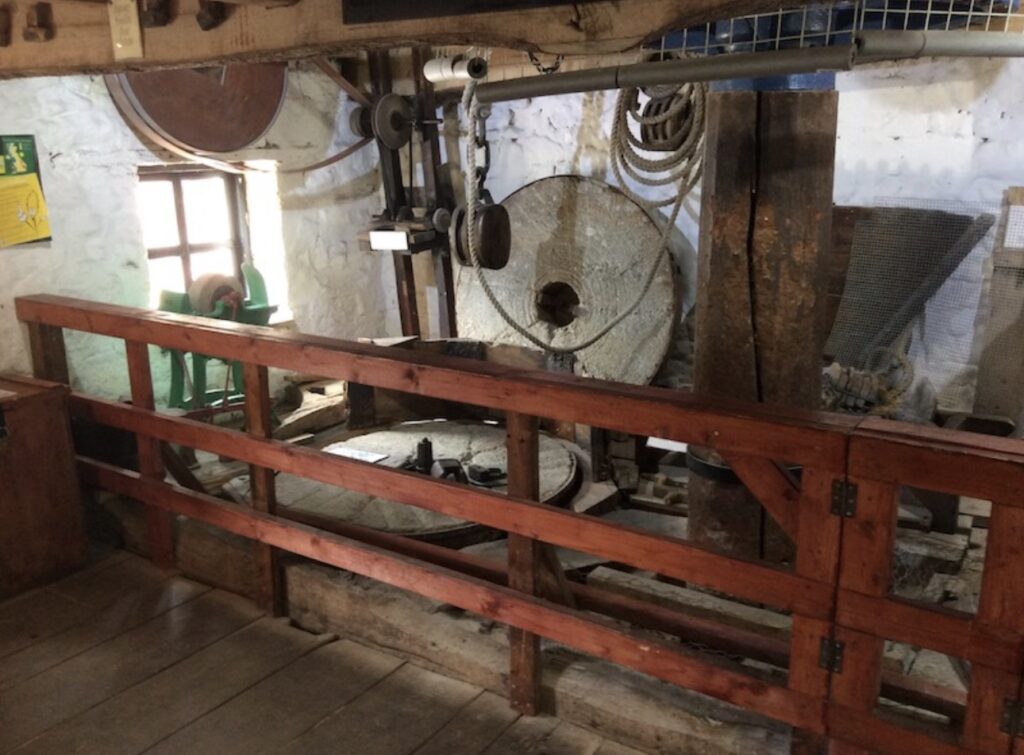
Here are the Mill’s two pairs of millstones; one set still in use in its wooden casings.
Flour making courses available to book here: -Click Here to Book-
Flour on the right
The right-hand pair was for producing flour and the stones are known as “French burrs”. Each millstone was made of a number of blocks of chert, a flint-like rock, which was quarried in France. The blocks are cemented together with plaster of Paris, and an iron band is then shrunk around the assembled blocks to hold them tight. Millstones of this type were the best in the world, and an example can be seen in the corner of the mill. We still grind wheat and other grain for flour and some quantities are used in our tearooms or sold bagged in our main shop.
Animal feed on the left
The left-hand stones are probably from Anglesey, each quarried as a single piece, and were used to produce animal feed. The stones are cut with lines or furrows in a distinct harp like pattern, which is known as “dressing” the millstone, and the furrows allow the stones to break open the grain and crush it into meal or flour. In time past rotten vegetables, gorse or even bones would have also been ground to make animal feed.
Flour Power
The bedstone is fixed, and the upper, or ‘runner’, stone rotates on it. The corn is fed into the centre, or ‘eye’ of the runner and the ground product works its way outwards, eventually finding its way down the meal spout on the floor below. The stones can work at speeds of 80-100 revolutions per minute and the gap between them reduces down until the stones are just touching thereby reducing anything between them to a fine powder.
Overhead you can see the loft, which houses the sack hoist and is used to lift sacks from the ground floor to the millstones. There is another gear on the top of the upright shaft called the crown wheel which drives two more pulley lines for working other equipment, typically a small grinding stone for sharpening tools.
You’ll have noticed that much of the Mill equipment is made from wood, especially the larger gears which all have wooden ‘teeth’. This allowed for cheaper maintenance costs and also cuts down on the risk of sparks when the machinery is working – a spark or naked light could cause an explosion in a flour mill as flour dust is highly explosive!
Before you leave this room have a go at grinding corn by hand on the quern stone. You will also see a blue mobile mill here. The significance of this machine is that it brought an end to mills like this as mobile mill could be taken straight to the farmyard. This completely reversed the business. That’s why you may see lots of Mill Streets across the country, but no actual mills.
Directions to the Woodturner’s Room
As you leave the grinding room and turn to your lett you will see the Coracle Display within the mill leat (the water supply for the waterwheel).