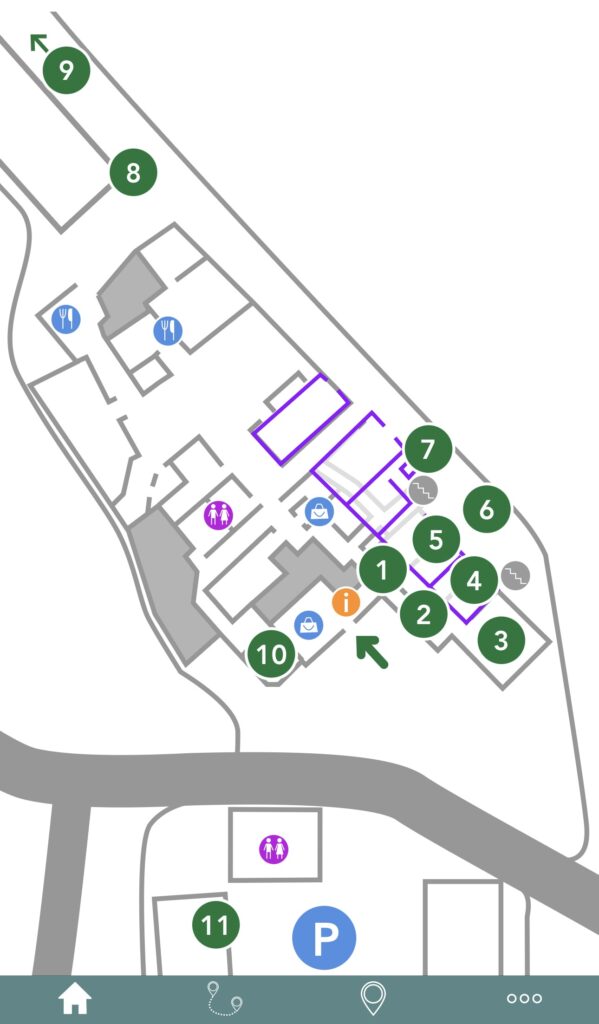
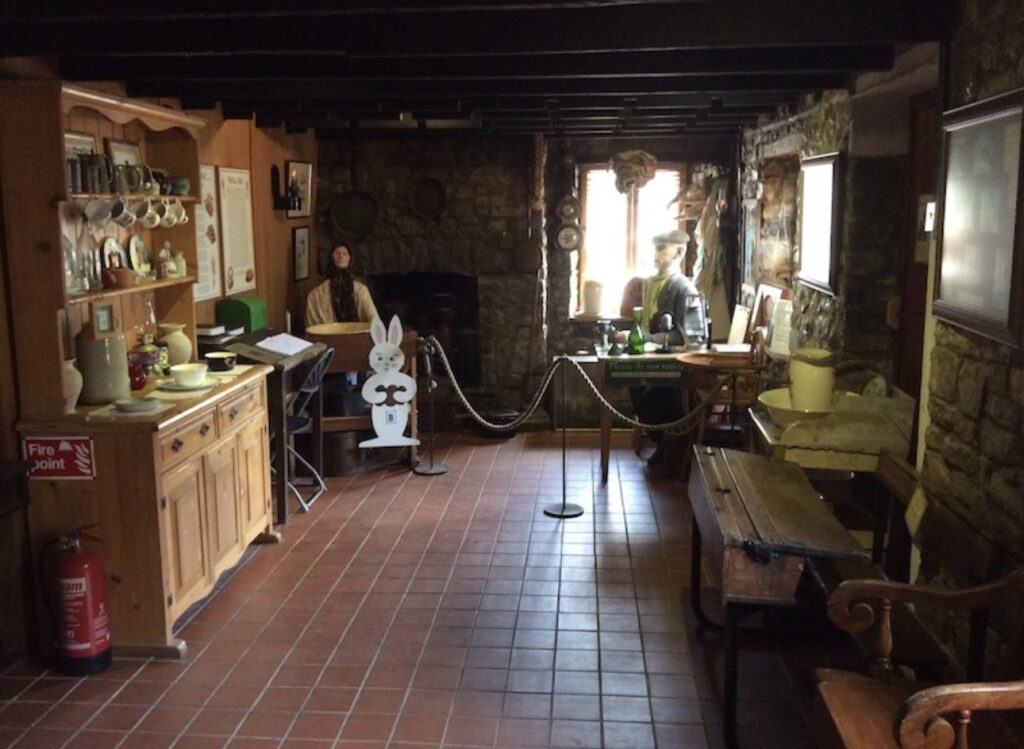
When William Davies became the tenant of the mill in the 1700s, he built this cottage right next to the Mill Building. It was constructed in the traditional style of the area; a simple cottage comprising one large room downstairs and 3 small bedrooms upstairs. It could have housed as many as 11 people at one time!
Which Prime Ministers family stayed here?
In the 1910s members of the Churchill family were guests of the Lord of Gower at Parc le Breos ‘shoot’. They used the upstairs part of their cottage as their billet. And today the upper parts are now used as holiday accommodation.
As the Davies family expanded, other cottages were built in the lanes approaching the Mill. Before 1890 the lane outside the front of the Mill was the main South Gower road. It was the motorway services of its time. By the 1920s the family were able to purchase the freehold of their properties from the local estate which by now had been transferred from the Duke of Beaufort to the Penrice Lyons family who lived in nearby Kilvrough Manor.
Did the Mayor of Gower live here?
The Miller at Parkmill commanded respect and admiration throughout the Ilston area. As such he was regarded as a kind of de facto mayor, often officiating at village functions as you can see by the collection of photos in the cottage. You can also meet a model of a previous Will the Mill and listen to a story that was recorded for BBC radio here in 1948.
The Corn Mill
When you are ready, step out of the cottage to take a closer look at the ground floor of the Corn Mill – getting to work was really easy for the Miller and his family! Can you see all the main cogs and gears that make all the equipment work – it’s really a very large gearbox!
Where’s the pit wheel?
At the back of the room you will see on the waterwheel-shatt, a large gear called the pit wheel because its lower half is within a pit. It drives the smaller iron wheel (or wallower gear) on the upright shaft. The wallower gear drives the large cog (or great spur wheel on, the upright shaft) and this cog transfers power to smaller cogs you can see ready to connect to the great spur wheel. The power of the waterwheel is thus transferred into speed with the smaller cogs driving equipment at a ratio of 10-1 times faster than the water wheel.
Wooden or iron teeth?
The spur wheel is the large horizontal gear on the wooden upright shatt. It connects with three small cogs or pinions, speeding up their rotation even more. Two of these three pinions drive pairs of millstones on the floor above.
The third pinion is on a shaft down to iron gears; this is the drive to the circular saw. You will notice that some gears have wooden cogs instead of iron teeth. This was to make a quieter and smoother drive. Also, if anything jammed-up, the wooden cogs would break off and the precious iron gears would be unharmed.
Flour Spouts – making a meal of it
The flour or ‘meal’, produced from the millstones on the upper floor, would come down wooden spouts into sacks or a collecting box, and the quality would be felt by the miller. Using the ‘rule of thumb’ he would adjust the handle (on the vertical wooden beam) – which changed the gap between the millstones, thus controlling the fineness of the meal – until the product felt just right.
Mill-enia
Milling has been carried out here for 1000 years, with farmers meeting the Miller on this very spot to agree how the work was to be done and at what cost. In the 1920s a typical charge for grinding was 4p/bag of wheat and 2p/bag of oats – oats were cheaper as they were a softer grain and could be ‘coarse ground’ for animal feed.
When the mill was owned by the Lords of Gower, they could take up to 10% of farmer’s produce brought to grind here. Read more about this ‘toll mill’ on the Welcome page.
Directions to the Flour Grinding Mill
An external staircase at the back of this room will take you to the next floor of the Mill. If you cannot use the stairs please use the ramped walkway. To get to the ramped walkway, return back past Reception, follow the path through the next building and head up the ramp on the right to the next level. Turn right to reach the Flour Grinding Mill.