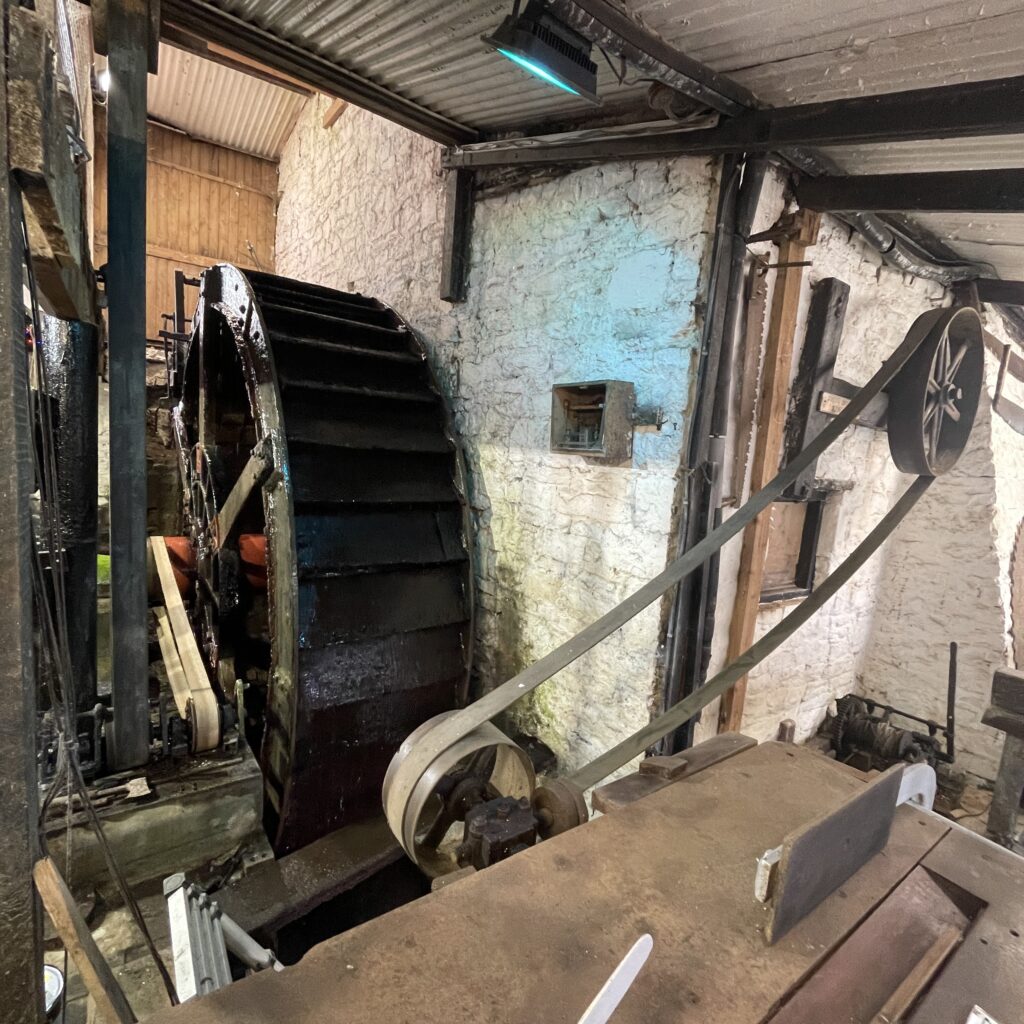
This 12th century building is the oldest commercial building operating in Gower. A waterwheel has been turning here since that time (although this one dates from the 18th century). Its original purpose was to drive millstones to grind up grain for food.
Waterwheels can operate by the water flowing underneath (an undershot wheel) or flowing over the top (an overshot wheel). This high-breastshot waterwheel combines both methods, using the weight of the water to start the wheel turning and then the movement underneath to keep it going.
Water is carried here along the mill leat at the back of he building and fills 42 ‘buckets’ or wooden troughs at a point high up on the back or ‘breast’ part of the wheel. The speed of the wheel is regulated by the amount of water we allow to flow through the launder gate or valve behind the wheel. Can you see the control handle?
Did you know that this waterwheel…
- Is about 300 years old – King George I was probably in power when it was fitted
- Measures 14 feet 6 inches (4.42 metres ) in diameter
- Weighs 5 1/2 tons – the same as a fully grown Asian elephant
- Is made of cast-iron and oak – you’ll learn more about this in the Mill cottage
- Can rotate at nearly ten revolutions per minute – how long does it take to make one full turn?
- Generates over six Horsepower – the same as an outboard motor on a small boat
Waterwheels were originally made completely from wood. From the 17th century, iron parts became more common and we know from markings on our wheel that some of the ironwork was probably made in Priory Foundry in Carmarthen, sometime in the 1700s.
The wheel is constantly being repaired, so if it is not working today we are probably undertaking maintenance.
The Wheel Shaft
The present shaft is made of metal and was fitted in 1999, replacing the oak predecessor that can be seen by the workbench on the other side of the room, opposite the wheel. The oak shaft had previously been fitted in 1890 when there was a major overhaul of the mill equipment. We have an invoice from the timber company, boasting that the shaft was guaranteed to last 100 years – it exceeded that claim by 9 years!
Today we repair the wheel when anything needs changing, usually the wooden buckets and oak arm shafts. The buckets are always loosening under the water pressure and need constant attention. To get the wheel to run smoothly we also place lead weights to the inside of the rim so that its weight is balanced out evenly as it turns on its axle – just like a car tyre. The axle runs through a hole in the wall of the Mill and through the ground floor where it connects with a system of gears that drive all the Mill equipment.
What is a tailrace?
This is the water channel underneath the front of the waterwheel. From here water flows into an underground culvert, called the tailrace, under the front courtyard outside and all the way under the car park until it joins the river from Ilston valley on the other side of the main road.
Nearly one mile of water courses allow the water to maintain a downhill flow, and is testament to the skull of the Norman engineers who would have worked out where to position their Mill Building. It still works perfectly today more than 900 years later.
Directions to the Circular Saw
Over the centuries the waterwheel has been used to power various equipment that you will see along your journey around the mill. Any of these other industrial processes were started by various Will the Mills over the years.
Make your way around the corner, go past the circular saw to see the other saw blades against the wall.