For the first 300 years of its life the Mill building was part of the Lord of Gower’s Estate, often being used by farmers themselves under the watchful eye of the Lord’s ‘Reeve’, who would collect the toll and surplus produce.
Successive generations of Will the Mill’s family diversified their activities here by becoming woodworkers , sawyers, coffin makers (examples of their work can be found within the museum), blacksmiths and wheelwrights.
This circular saw is powered using gears and a belt drive driven by the waterwheel axle. All the timber originally used was locally produced – mainly oak and beech – from Parc Le Breos woodland. In fact the sawmill work eventually overtook the business of of grinding grain and many farmers in Gower will remember this more as a sawmill than a flour mill.
id you know that this waterwheel…
- Is about 300 years old – King George I was probably in power when it was fitted
- Measures 14 feet 6 inches (4.42 metres ) in diameter
- Weighs 5 1/2 tons – the same as a fully grown Asian elephant
- Is made of cast-iron and oak – you’ll learn more about this in the Mill cottage
- Can rotate at nearly ten revolutions per minute – how long does it take to make one full turn?
- Generates over six Horsepower – the same as an outboard motor on a small boat
Waterwheels were originally made completely from wood. From the 17th century, iron parts became more common and we know from markings on our wheel that some of the ironwork was probably made in Priory Foundry in Carmarthen, sometime in the 1700s.
The wheel is constantly being repaired, so if it is not working today we are probably undertaking maintenance.
Top Dog or Under Dog
The large hand saws on the wall above are called dog saws. They were used by two men in a saw pit in the front courtyard. One sawyer, ‘the under dog’, worked his end of the saw down in the pit, getting covered in saw dust and muck. the ‘top dog’ worked from above, and a the pair cu up lengths of tree trunk in preparation for the circular saw to reduce them into planks.
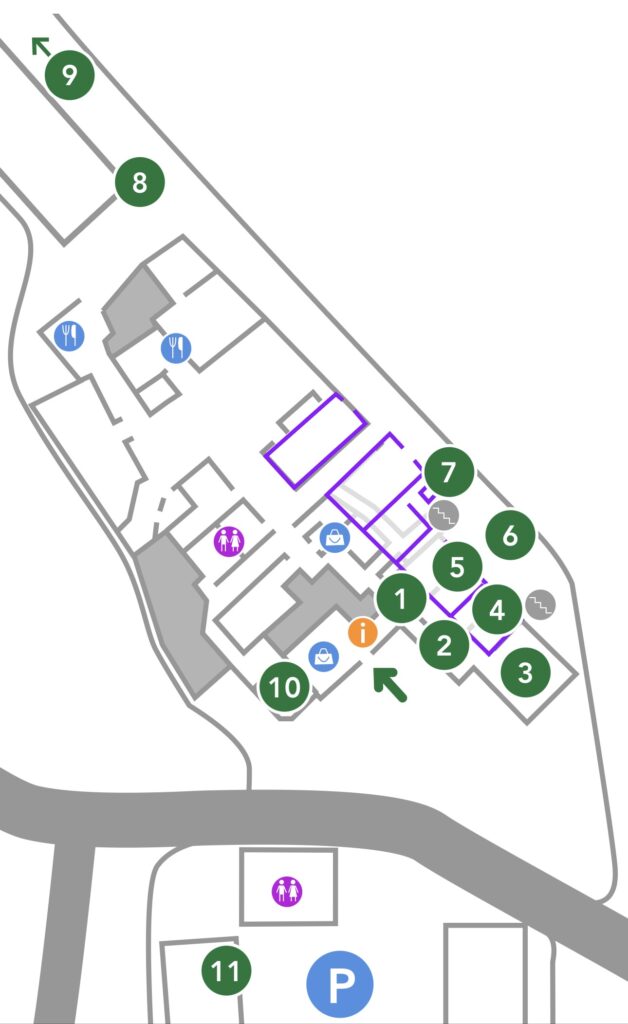
Directions to the Corn Mill and Cottage
Continue along the corridor and enter into the Mill Cottage.